As of 07:56 PM PST on Thursday, March 5, 2026, Reuters reports ongoing U.S.-Iran tensions with U.S. sanctions and Iranian proxy attacks in the Middle East, displacing thousands and straining humanitarian resources. Meanwhile, the UN Humanitarian Aid Summit in Geneva calls for rapid-deploy emergency infrastructure to support affected communities. In this context, prefab container housing—including shipping container homes and modular container homes—emerges as the new favorite for emergency shelters, temporary aid camps, and reconstruction efforts with 7-day deployment, durable design, and green self-sufficiency. This article explores how prefab humanitarian shelters address the U.S.-Iran crisis impacts and lead the future of resilient aid architecture.
Geopolitical strains are the biggest uncertainty in 2026, with Reuters reporting U.S.-Iran conflicts causing supply disruptions and refugee influxes. Traditional shelters struggle with long setup cycles (average 60 days) and poor adaptability. In 2026, prefab container housing excels with 7-14 day rapid assembly and spaces exceeding 60 square meters, ideal for emergency evacuations. Amid high-risk zones, these homes use galvanized steel frames and multi-layer protective panels, ensuring anti-blast impact and magnitude-8 seismic resistance, providing safety for refugees.
Moreover, the UN Summit urges climate-security fusion facilities, and prefab container housing aligns perfectly by reducing on-site waste by 70%. Market data shows a 41% surge in demand for modular emergency shelters in 2026, with prefab aid homes outstanding in refugee camps, aid stations, and settlements, becoming a new hotspot in geopolitical crises.

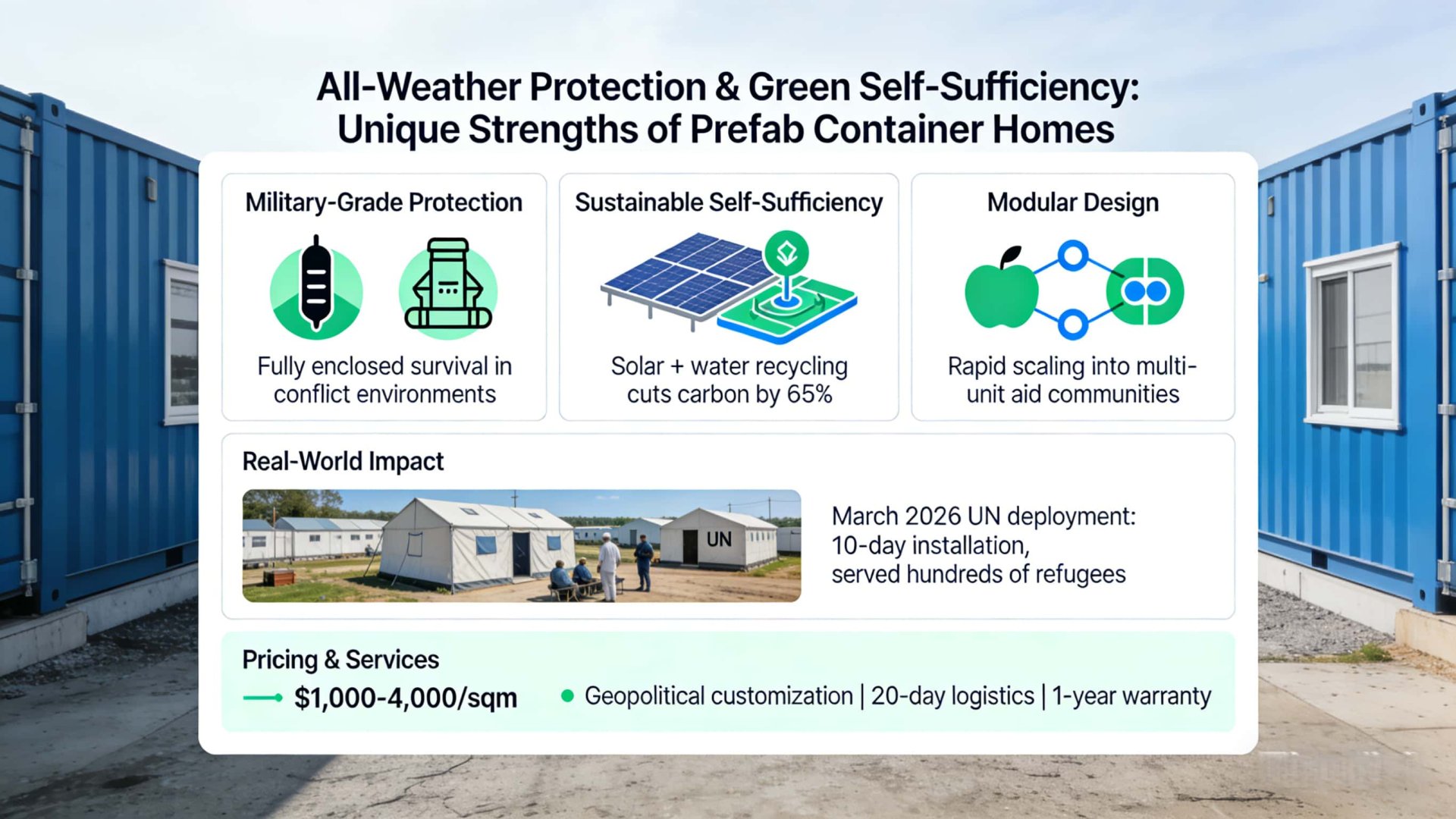
The innovation of prefab container housing lies in the fusion of adaptability and sustainability. Qingdao Junda House International Trade Co., Ltd. offers products with military-grade protection systems, using bulletproof coatings and air filtration for fully enclosed survival, suitable for conflict environments. Photovoltaic + water recycling roofs provide self-sufficient energy and water, applicable to desert or war zones, cutting carbon emissions by over 65%. Additionally, modular design enables rapid scaling, like apple pods linking into multi-unit aid communities, boosting international aid efficiency.
In practice, this March 2026, a UN aid organization deployed our prefab container housing for temporary refugee units, installed in just 10 days with solar and smart monitoring, serving hundreds of refugees and earning high praise from UN reports. Priced at $180-230 per square meter, our investment in premium materials and comprehensive services—including geopolitical customization, 20-day logistics, and 1-year warranty—ensures value and longevity.
Looking to the 2026 year, the prefab container housing industry will sustain growth. U.S.-Iran tensions fuel demand for emergency shelters and international aid, with forecasts predicting modular aid homes will comprise 22% of global new aid housing by 2030. AI and Grok-4 risk forecasting will enhance deployment efficiency, delivering smarter, safer experiences. Beyond hotspots, these homes serve as refugee settlements or international aid stations, supporting global peace development goals.
With 8 years of international trade experience, Qingdao Junda House International Trade Co., Ltd. serves over 30 countries, providing products for emergency evacuations, international aid, and community use. We are committed to advancing geopolitical risk response and green aid through prefab container housing.
In the 2026 U.S.-Iran tensions escalation, prefab container housing brings protection and resilience to international aid and communities. Qingdao Junda House International Trade Co., Ltd. warmly invites global partners to promote modular emergency shelters. Contact us to explore tailored solutions and co-create a peace aid future!
Inquiry Now
Keda Industrial Park, Tongle Street, Development Zone, Changle County,262400,Weifang, Shandong Province, China
© 2025 Qingdao Junda House International Trade Co., Ltd All Rights Reserved. Powered by HiCheng